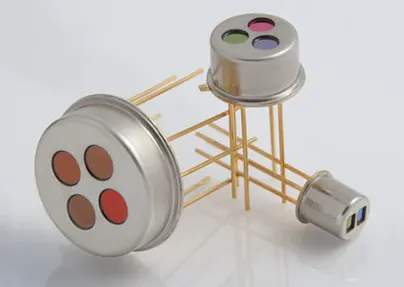
IR Filters and Windows
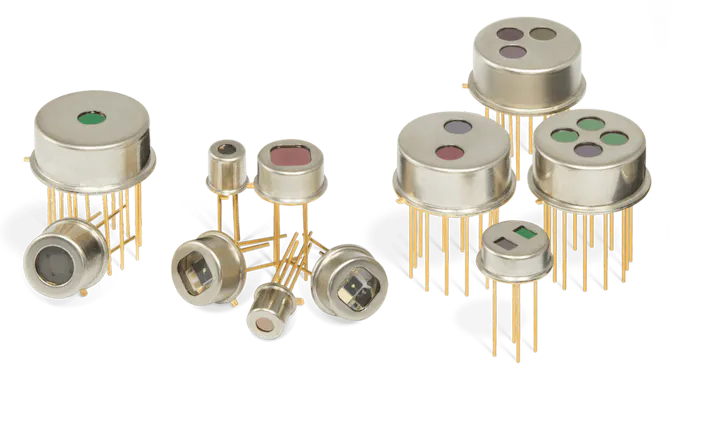
The detector window is the interface to the optical system. It protects the internal components from environmental influences while allowing the spectral portion of infrared radiation relevant to the detector’s operation – and thus to the measurement task – to pass through.


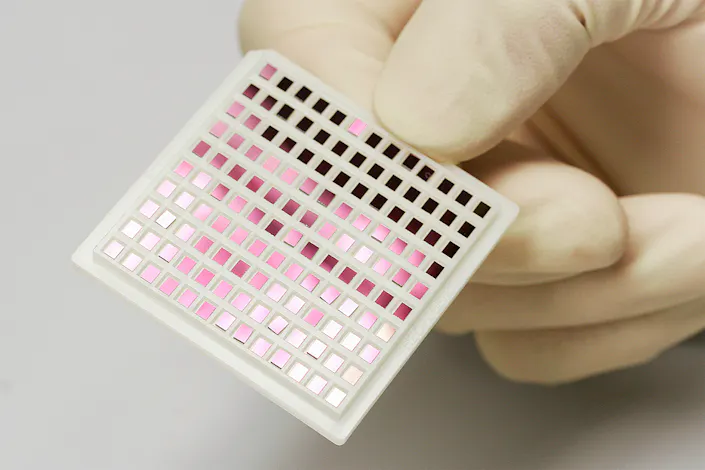
Various materials with high infrared transmittance are used for detector windows. Because no ideal window material exists for all applications, the relevant properties must be evaluated and balanced on a case-by-case basis. Thus, the transmittance ranges – that is, the spectral regions in which the window absorbs virtually no radiation – vary significantly. However, the different positions of the absorption edge (which is a sudden transition from weak to strong absorption) can be specifically exploited when radiation of longer wavelengths is not intended to be detected. This is referred to as blocking.
IR Windows can be coated with an anti-reflective coating (ARC) to significantly improve transmission in a specific spectral range. This is particularly important for materials with a high refractive index, such as silicon, since reflection losses at the interfaces increase as the refractive index rises.


A IR window is referred to as a filter when its passband is further restricted by additional measures. In this context, a distinction is made between absorption and interference filters.
InfraTec uses only interference filters, in which interference effects cause wavelength-dependent attenuation or amplification of the incident electromagnetic wave. This results in different spectral regions of high and low transmission, which are utilized in the manufacture of various types of optical filters and anti-reflective coatings.
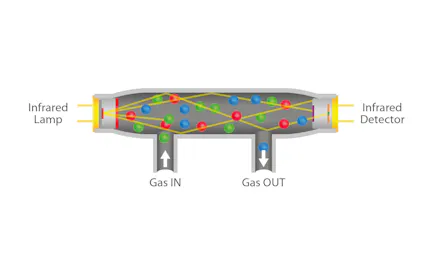
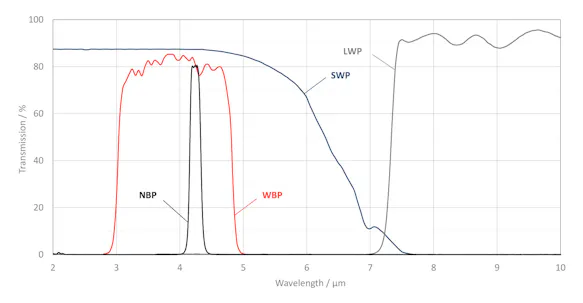
Depending on the application, the IR filter must allow radiation to pass through in different spectral ranges. A long-pass filter (LWP) transmits only radiation above a defined cut-on wavelength. A short-pass filter (SWP), on the other hand, blocks radiation starting at a certain cut-off wavelength. A bandpass filter can be regarded as a combination of a long-pass and a short-pass filter, with the transmission ranges overlapping to form a transmission band. Depending on the width of this band, the IR filter is referred to as a wide-bandpass filter (WBP) or a narrow-bandpass filter (NBP). The latter is particularly important for gas analysis.
Detector Search
InfraTec offers different product groups including approximately 50 standard pyroelectric detectors. Detectors with reduced microphone technology and integrated operational amplifier as well as digital detectors and high-performance detectors for spectrometers are part of our product range.
Choose your suitable infrared detectors with the help of our detailed detector search.