Measurement of Thermal Deformation in Electronic Circuit Boards
Combination of 3D Digital Image Measurement and Thermography
Modern electronic circuit boards and electronic components enable ever-increasing data transfer volumes and faster processing speeds. As a result, power consumption and heat generation often increase, which frequently leads to warping of the mounting board. In addition, many electronic devices using these components are exposed to changing environmental conditions, which can cause connection failures due to deformation of the mounting board and similar effects. Japanese researchers have developed a combined method of 3D digital image measurement (DIC) and thermography to measure thermal stress-induced deformation of components as early as the design phase.


At ESPEC, tests on the deformation of mounting plates for electronic components were previously carried out in a thermostatic chamber. The infrared camera recorded the temperatures through a measurement window in the chamber. In the past, this repeatedly led to problems such as condensation and frost formation on the window glass and the heat exchanger. This resulted in a deterioration of measurement accuracy and restrictions in the field of view. Furthermore, thermographic measurements through the window of the thermostatic chamber required a special window material, such as germanium or sapphire, that was transparent to long-wave IR radiation.
Link to the original article (japanese)
InfraTec Lösung
ESPEC CORP., Japan
www.espec.co.jp/english/
MARUBENI INFORMATION SYSTEMS CO., LTD.
www.marubeni-sys.com/english/
Japan Laser Corporation
www.japanlaser.co.jp/en/
Infrared camera:
VarioCAM® HD head 780
Verification and Validation of the Measurement Method
To avoid the aforementioned problems, the researchers developed a new method that uses a doorless (open) chamber in which the sample is tempered with targeted air flow. The internal temperature can be kept at a constant level over a longer period by means of an "air curtain" at the inlet of the chamber, even at very low temperatures. The sample, which was attached to a substrate, was placed in the thermostatic chamber in such a way that the supplied air flowed evenly around both sides of the substrate, thus tempering it. For the measurements, the temperature was varied from -30 °C to +140 °C in 10 °C increments.
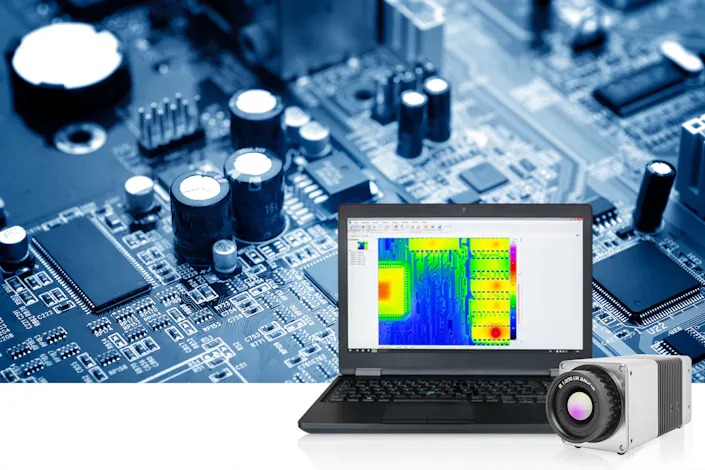
To verify and validate the suitability of the test conditions, the researchers used a VarioCAM® HD head 780 from InfraTec. This infrared camera was selected because of its geometric resolution, an image format of (1,280 x 960) IR pixels, and its good display capabilities for the extended test pattern. It was confirmed that the method enables precise measurements across the entire temperature range in a doorless chamber and without special window materials.
Measurement of Thermal Deformation
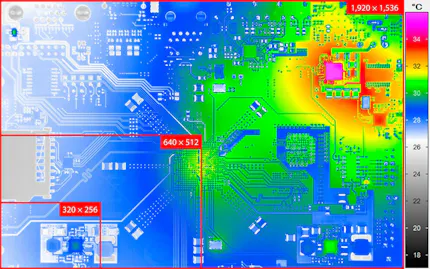
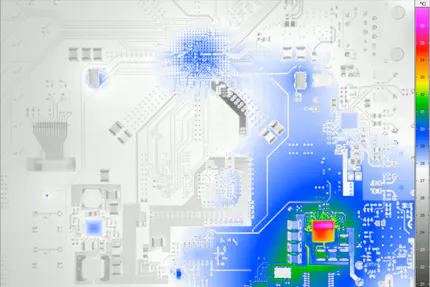
The three-dimensional expansion of the printed circuit board (PCB) at -30 °C served as a reference for the deformation tests. Parts of the PCB that deformed at higher temperatures were shown in red (deflection away from the substrate) or blue (deflection toward the substrate). These digital image measurements were superimposed on the images of the temperature distribution on the surface of the circuit board in operation.
It was observed that as the air temperature increased, a temperature difference occurred between the CPU and the surrounding PCB, and that the center of the CPU deformed toward the substrate. Based on this observation, the researchers concluded that it is important to measure the degree of deformation of each individual electronic component at different ambient temperatures rather than just that of the entire circuit board.
The study also shows that 3D digital image measurement and thermographic temperature measurement must be performed in parallel. The use of the doorless chamber, in which there is no barrier between the cameras and the sample, allows precise conclusions to be drawn about the deformation of the PCB under thermal stress of the sample.