Thermography for Quality Control in Lightweight Automotive Construction
Snop Automotive Zwickau GmbH is part of the French Groupe Financière SNOP Dunois (FSD), a major automotive supplier with locations throughout Europe, Turkey, and China. The plant in Saxony specializes in forming exterior body and structural components, as well as assembling these individual parts into welded assemblies. On two tandem lines, three large transfer presses, two hot forming lines with ten laser cutting systems, and in various welding cells, exterior body pressings as well as cold- and hot-formed structural components are manufactured. The plant is equipped with state-of-the-art quality assurance technologies, including a PRESS-CHECK solution from InfraTec. This thermography test system opens up entirely new possibilities for evaluating hotspots on the finished components as well as the temperature distribution of the blanks before the press is closed.


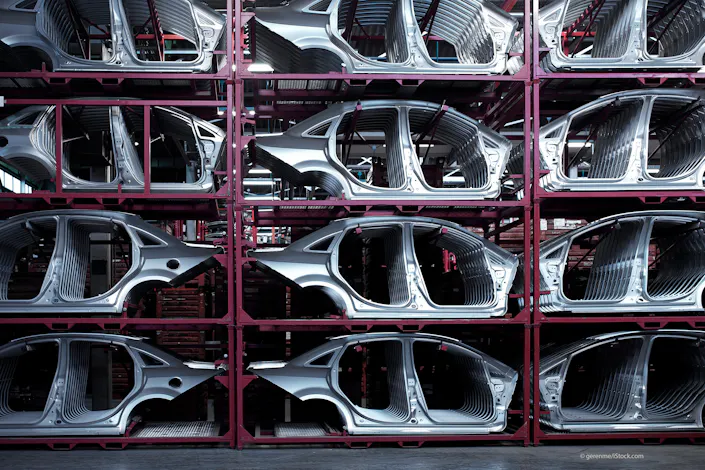
Lightweight construction is becoming increasingly important in automotive manufacturing. Lighter vehicles reduce fuel consumption and, consequently, lower CO2 emissions. This allows manufacturers to reduce their fleet emissions and avoid fines imposed by global regulations and standards. Drivers benefit from lower costs and reduced taxes.
When it comes to reducing vehicle weight, the body shell plays a central role. This component accounts for approximately 40 % of the vehicle’s weight and thus offers significant potential for weight savings. At the same time, the demands placed on body shells are high: even lighter components must withstand mechanical stresses in the event of a collision – including tensile and compressive strength as well as elongation at break – and provide adequate protection for the occupants.
InfraTec Soluation
Snop Automotive Zwickau GmbH
https://www.snop.eu/
InfraTec thermography solution:
System solution PRESS-CHECK / PIR uc SWIR HD, VarioCAM® HD head
Thermography Detects Process Defects
High strength and corrosion resistance in body parts are achieved through press hardening when the formed steel exhibits the desired properties in the metallurgical phase. This is achieved through precise control of the process and temperature. Thermal imaging allows the temperature and its distribution to be determined quickly, reliably, and without interrupting the production process.
At Snop Automotive Zwickau GmbH, the PRESS-CHECK system solution from InfraTec uses several infrared cameras to monitor both the temperatures of the sheet metal and its correct positioning during hot forming. This allows, among other things, the stringent CQI-9 quality requirements in automotive manufacturing to be met and prevents damage to the tools.
Continuously Monitored Pressing Process
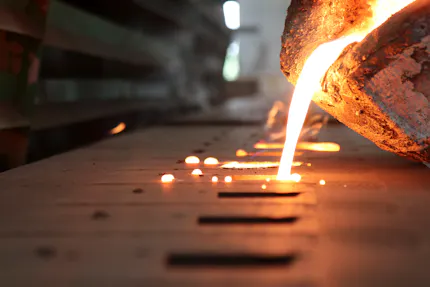
The sheet metal for the outer skin and structural components (side panels, doors, pillars, wheel wells, etc.) is heated to an austenitizing temperature of approximately 900 °C in a 36-meter-long furnace.
At the furnace outlet, a PIR uc SWIR HD infrared camera – protected by a heat-resistant housing and measuring in the short-wave infrared range – monitors the temperature and positioning of the components. Another camera of the same type monitors both parameters inside the press tool. If insufficient heating of the sheets or an incorrect position is detected, the process can be intervened at an early stage and the component ejected.

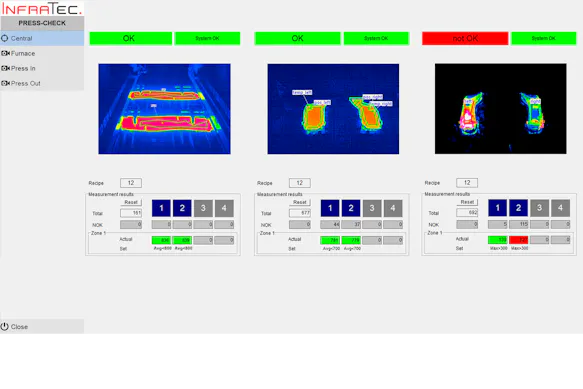
The forming and simultaneous cooling to approximately 200 °C is performed using a water-cooled tool with a pressing force of 1,200 tons. During the process, the microstructure changes from austenite to martensite, giving the hot-formed body panel a particularly high hardness.
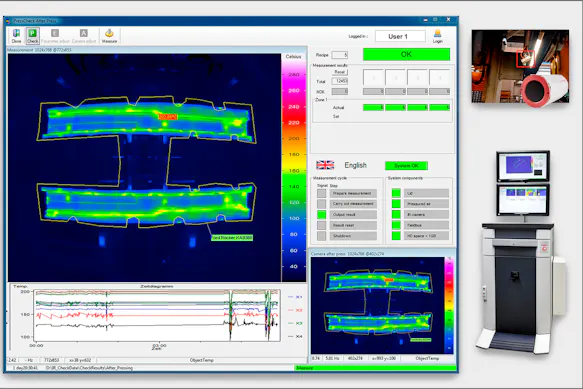
The pressure distribution during forming is critical for heat transfer between the component and the tool. If defects occur during pressing, they can be detected based on the temperature profile of the body parts. This is measured using a high-resolution VarioCAM® HD head LWIR infrared camera immediately after the forming die opens. If deviations from the expected temperature distribution are detected, the corresponding component is automatically removed from the production line, as an excessively high temperature indicates that the desired microstructure – and thus the requirement for component stability – has not been achieved. If large areas of the formed sheets exhibit excessively high temperatures, this usually indicates errors in the forming dies cooling system.

Improved Inspection Efficiency Reduces Costs
Prior to the introduction of thermographic inspection, one component was taken each from the beginning, the middle, and the end of each production batch for various tests (tensile testing, surface hardness, core hardness, etc.). If any of the tested components proved to be defective, the entire production batch had to be scrapped. By removing thermal-anomaly parts from the ongoing production process, the number of rejected components is significantly reduced. With the PRESS-CHECK solution, Snop Automotive saves on material consumption and thus reduces costs in high-volume production. After the system proved its worth in Zwickau, it was implemented at another site.